Site Update: Sony a7c Camera
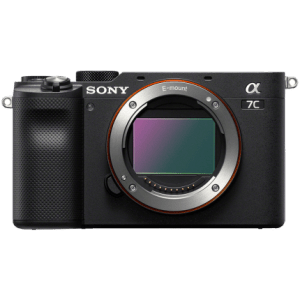
Product highlights
- World’s smallest and lightest full-frame camera
- Advanced 24.2MP Back-Illuminated 35mm Full-frame Image Sensor
- 4K Movie w/ full pixel readout, no pixel binning or crop and HDR
- 15-stop dynamic range, 14-bit uncompressed RAW, ISO 50 to 204,800
- 693 phase-detection / 425 contrast AF points w/ 93% image coverage
- Real-time AF Tracking, Real-time Eye AF and Animal Eye-AF
- 3” flip-out, vari-angle LCD makes framing and vlogging easy
- 5-axis in-body image stabilization, 5-step shutter speed advantage
- Up to 10fps Silent11 or Mechanical Shutter with AE/AF tracking
- Long-lasting Z battery for up to 740 images or 220 min. for movie
- Multi Interface Shoe™ for flash or digital audio with external mic.
- Compact, dust and moisture resistant, monocoque magnesium alloy body
- Camera control and file sharing with Android and iOS smartphones
- High-speed 2.4 and 5GHz Wi-Fi / FTP transfer and wireless PC remote
- SuperSpeed USB Type-C™ (USB 3.1 Gen 1 compatible) and Micro USB
- No 29m 50s continuous recording limit for movie shooting
- Fast, wide, dependable 4D Focus w/ Eye AF, Lock-on AF, AF tracking
- 7x adjustable AF Transition Speeds, 5x AF Subject Shift Sensitivity
- S-log / 3 workflow plus instant HDR with Hybrid Log-Gamma (HLG)
- Headphone, mic jacks and HDMI port
Before I talk about the new camera, let me tell you about my personal road that lead me here. I got into the Sony lens camera with the Sony NEX-3N camera in May 2013… this was an upgrade from my Micro 4/3 Olympus PEN E-P1 (which I had since Oct 2009).
The Sony NEX cameras evolved to what we know today as the Alpha (α) cameras. Sony was smart in their designs, because all these cameras shares the same lens interchange system called E-Mount. This is amazing, you can use any E-Mount lens on a variety of Sony products, including Sony α, SmartShot, Handycam, NXCAM or XDCAM systems.
So, going from my NEX camera to my first α (which I purchased in May 2016), I just reused my NEX lens on the new camera. This is such a cost-saving thing that I’m basically locked into the Sony system – thanks to their lens design.
For the uninitiated, I’ll break down Sony’s confusing camera naming system for their Alpha (α) cameras:
• α6000-6400: Advance consumer level ($800-$1k)
• α7: Basic Full Frame ($2k), which also includes α7R for Resolution ($3k) and α7S: Sensitivity ($3.5)
• α9: Flagship ($4.5k)
• α1: Ultimate Flagship ($6.5k)
As you can see, the two flagship α9 and α1 (which was introduced this year) are not affordable. My best option is the α7 (3rd revision), which costs about $2k.
That price is still pretty high, considering there are cheaper alternative cameras with similar specs… however, none of those other cameras will work with my E-Mount lenses or capable of “eye detection” or incredibly fast auto focusing system that Sony developed with the a6000. At the time of its release, Sony boasted it had the fastest auto focusing system.
So, anyway, my next camera is the “Compact” Sony α7c. I have wanted this camera since it was announced in September 2020. It’s basically an α7III, but smaller (and slightly cheaper). A lot of reviews don’t like the 7c because they think it’s too small and prefers the larger and heavier 7III… but the way I see it, I don’t think they have a good argument. They don’t understand that not everybody wants bigger and larger, but prefers smaller and compact.
Now for the bad news, while I am looking forward to the full frame camera, it’s quite an expensive jump to this format. Although my old APS-C lenses will work on this new camera, it doesn’t take advantage of the full 35mm frame. Full frame lenses are all triple the price (or more) of the standard APS-C version. For example, an APS-C 70-200mm lens will cost about $250… the same equivalent full frame lens will cost $1000.
My biggest issue, by far, with my A7C is the abysmal battery life. I heavily researched it prior to purchasing, and noted mentions of non-class-leading battery life, but it is considerably worse than I anticipated. Otherwise, I am happy with the camera.